Half-Life 2: Deathmatch — System Requirements, FPS Estimate & Settings
2004 · Action · Valve Software · ESRB Mature
Official system requirements
Publisher-published Minimum / Recommended values via RAWG, retrieved 2026-08-21. Real-world performance varies with drivers, resolution and your full build.
| Spec | Minimum | Recommended |
|---|---|---|
| OS | Minimum: 1.2 GHz Processor, 256MB RAM, DirectX 7 level graphics card, Windows XP, Mouse, Keyboard, Internet Connection | — |
| Processor | Recommended: 2.4 GHz Processor, 512MB RAM, DirectX 9 level graphics card, Windows XP, Mouse, Keyboard, Internet Connection | — |
| Memory | — | — |
| Graphics | — | — |
Multi-GPU FPS estimate
Estimated average FPS by GPU at 1080p / 1440p / 4K, derived from Half-Life 2: Deathmatch's demand tier (tier 2, Light (entry discrete GPU)) and published TechPowerUp-style relative-performance indices (RTX 4090 = 100), retrieved 2026-08-29. Planning estimates, not benchmarks.
| GPU | 1080p | 1440p | 4K |
|---|---|---|---|
| RTX 4090 | 392 | 259 | 149 |
| RTX 4080 Super | 351 | 232 | 134 |
| RTX 4080 | 338 | 223 | 128 |
| RX 7900 XTX | 375 | 248 | 143 |
| RX 7900 XT | 351 | 232 | 134 |
| RTX 4070 Ti Super | 300 | 198 | 114 |
| RX 7800 XT | 300 | 198 | 114 |
| RTX 4070 Super | 282 | 186 | 107 |
| RTX 4070 | 264 | 175 | 101 |
| RX 7700 XT | 272 | 179 | 103 |
| RTX 3070 | 247 | 163 | 94 |
| RX 6800 XT | 296 | 196 | 113 |
| RTX 4060 Ti | 217 | 143 | 83 |
| RX 6700 XT | 264 | 175 | 101 |
| RTX 3060 | 199 | 131 | 76 |
| RX 6600 XT | 225 | 148 | 85 |
| RTX 2060 | 180 | 119 | 68 |
| GTX 1660 Super | 149 | 98 | 57 |
| RX 580 | 172 | 114 | 65 |
| GTX 1060 6GB | 141 | 93 | 53 |
| GTX 1650 | 112 | 74 | 43 |
| Intel Arc A770 | 228 | 151 | 87 |
| UHD 770 (integrated) | 46 | 30 | 17 |
Method: a game's demand tier maps to a “GPU index needed for ~60 FPS at 1080p”; each GPU's relative index produces an estimate via a diminishing-returns curve, then scaled for resolution. Source: TechPowerUp GPU database (relative performance), 2026-08-29.
Similar games you may tune next
Grand Theft Auto V
2013 · Action
Open profile →The Witcher 3: Wild Hunt
2015 · Action, RPG
Open profile →Tomb Raider
2013 · Action
Open profile →Portal
2007 · Action, Puzzle
Open profile →Left 4 Dead 2
2009 · Shooter, Action
Open profile →Red Dead Redemption 2
2018 · Action
Open profile →The Elder Scrolls V: Skyrim
2011 · Action, RPG
Open profile →Half-Life 2
2004 · Shooter, Action
Open profile →Optimize Half-Life 2: Deathmatch for your hardware
Pick your GPU, CPU, resolution and target refresh rate, then generate a printable settings card with per-preset expectations and upscaler guidance.
Optimize Half-Life 2: Deathmatch for your PC
This is a planning estimate derived from the game's demand tier, not a benchmark.
My Half-Life 2: Deathmatch Settings Card
Generated at GameFigs on 2026-09-25. Game demand tier: 2/9.
Release & version notes
Official release date: 2004-11-01. Ongoing patches and version history are published by the developer — for the latest patch notes, see the official store or support page. GameFigs summarizes the official release only and does not invent patch dates.
About Half-Life 2: Deathmatch
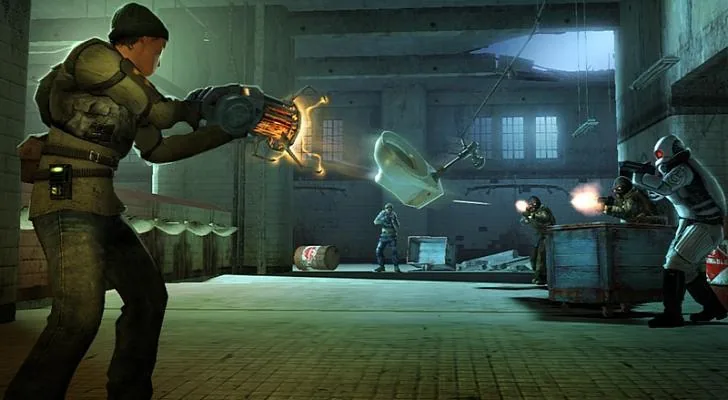
Upon the release of Half-Life 2 players were greatly disappointed in one thing, and that’s the lack of multiplayer. Granted, single-player campaign of Half-Life 2 was impressive, but weapons that have been demonstrated in it made players curious. They questioned if the experience was complete because the first Half-Life included multiplayer mode from the beginning. Valve took the criticism and published Half-Life 2: Deathmatch – multiplayer only addition, based on the main game, which was a separate product, distributed on Steam. The game includes two major modes, which are Deathmatch and Team Deathmatch. Both modes have similar rules. Players must kill as many other players as possible, to gain points. Player or team with the most points win, and points are retracted for self-killing and team killing. Players can expect fast-paced matches with instant respawns.
Sources & attribution
- Game data (release year, genres, platforms, system requirements, description, cover art) via RAWG.io, retrieved 2026-08-21.
- GPU relative-performance indices via TechPowerUp GPU database (relative performance), retrieved 2026-08-29.
- FPS estimates on this page are GameFigs planning estimates from the demand-tier + GPU-index model — not benchmark results.
How the Half-Life 2: Deathmatch optimization card & FPS estimate are computed
Each game is scored on a 0–9 demand tier from its published PC requirements (and a year/genre fallback when requirements are absent). The FPS estimate compares your selected GPU's relative-performance index against the tier's required index using a diminishing-returns curve, then scales for resolution. The settings card maps the demand tier and your hardware to a starting preset, an FPS band and an upscaler recommendation. All outputs are planning guides — verify in-game with the built-in benchmark when available.
Tools for Half-Life 2: Deathmatch
Check your hardware against this title, then set your gear up for it.