Journey — System Requirements, FPS Estimate & Settings
2012 · Family, Indie, Adventure · thatgamecompany · Metacritic 92
Official system requirements
Publisher-published Minimum / Recommended values via RAWG, retrieved 2026-08-21. Real-world performance varies with drivers, resolution and your full build.
| Spec | Minimum | Recommended |
|---|---|---|
| OS | Minimum: | Recommended: |
| Processor | OS *: Windows 7 (SP1+), Windows 10 and Windows 11 | OS *: Windows 7 (SP1+), Windows 10 and Windows 11 |
| Memory | Processor: Intel® Core™ i5 4570 or better | Processor: Intel® Core™ i7 5700k or better |
| Graphics | Memory: 8 GB RAM | Memory: 16 GB RAM |
| Storage | Graphics: NVIDIA GTX 1050 or AMD equivalent | Graphics: NVIDIA GTX 1080 or AMD equivalent |
| DirectX | DirectX: Version 10 | DirectX: Version 12 |
| Item 7 | Storage: 1 GB available space | Storage: 1 GB available space |
Multi-GPU FPS estimate
Estimated average FPS by GPU at 1080p / 1440p / 4K, derived from Journey's demand tier (tier 5, Moderate (mainstream GPU)) and published TechPowerUp-style relative-performance indices (RTX 4090 = 100), retrieved 2026-08-29. Planning estimates, not benchmarks.
| GPU | 1080p | 1440p | 4K |
|---|---|---|---|
| RTX 4090 | 150 | 99 | 57 |
| RTX 4080 Super | 135 | 89 | 51 |
| RTX 4080 | 129 | 85 | 49 |
| RX 7900 XTX | 144 | 95 | 55 |
| RX 7900 XT | 135 | 89 | 51 |
| RTX 4070 Ti Super | 115 | 76 | 44 |
| RX 7800 XT | 115 | 76 | 44 |
| RTX 4070 Super | 108 | 71 | 41 |
| RTX 4070 | 101 | 67 | 39 |
| RX 7700 XT | 104 | 69 | 40 |
| RTX 3070 | 94 | 62 | 36 |
| RX 6800 XT | 114 | 75 | 43 |
| RTX 4060 Ti | 83 | 55 | 32 |
| RX 6700 XT | 101 | 67 | 39 |
| RTX 3060 | 76 | 50 | 29 |
| RX 6600 XT | 86 | 57 | 33 |
| RTX 2060 | 69 | 45 | 26 |
| GTX 1660 Super | 57 | 38 | 22 |
| RX 580 | 66 | 44 | 25 |
| GTX 1060 6GB | 54 | 36 | 20 |
| GTX 1650 | 43 | 28 | 16 |
| Intel Arc A770 | 88 | 58 | 33 |
| UHD 770 (integrated) | 18 | 12 | 8 |
Method: a game's demand tier maps to a “GPU index needed for ~60 FPS at 1080p”; each GPU's relative index produces an estimate via a diminishing-returns curve, then scaled for resolution. Source: TechPowerUp GPU database (relative performance), 2026-08-29.
Similar games you may tune next
Limbo
2010 · Adventure, Action
Open profile →Garry's Mod
2004 · Adventure, Action
Open profile →Amnesia: The Dark Descent
2010 · Indie, Adventure
Open profile →Hellblade: Senua's Sacrifice
2017 · Indie, Adventure
Open profile →Hades
2020 · Indie, Adventure
Open profile →Bastion
2011 · Indie, Adventure
Open profile →ARK: Survival Evolved
2015 · Adventure, Action
Open profile →Brothers: A Tale of Two Sons
2013 · Indie, Adventure
Open profile →Optimize Journey for your hardware
Pick your GPU, CPU, resolution and target refresh rate, then generate a printable settings card with per-preset expectations and upscaler guidance.
Optimize Journey for your PC
This is a planning estimate derived from the game's demand tier, not a benchmark.
My Journey Settings Card
Generated at GameFigs on 2026-09-25. Game demand tier: 5/9.
Release & version notes
Official release date: 2012-03-13. Ongoing patches and version history are published by the developer — for the latest patch notes, see the official store or support page. GameFigs summarizes the official release only and does not invent patch dates.
About Journey
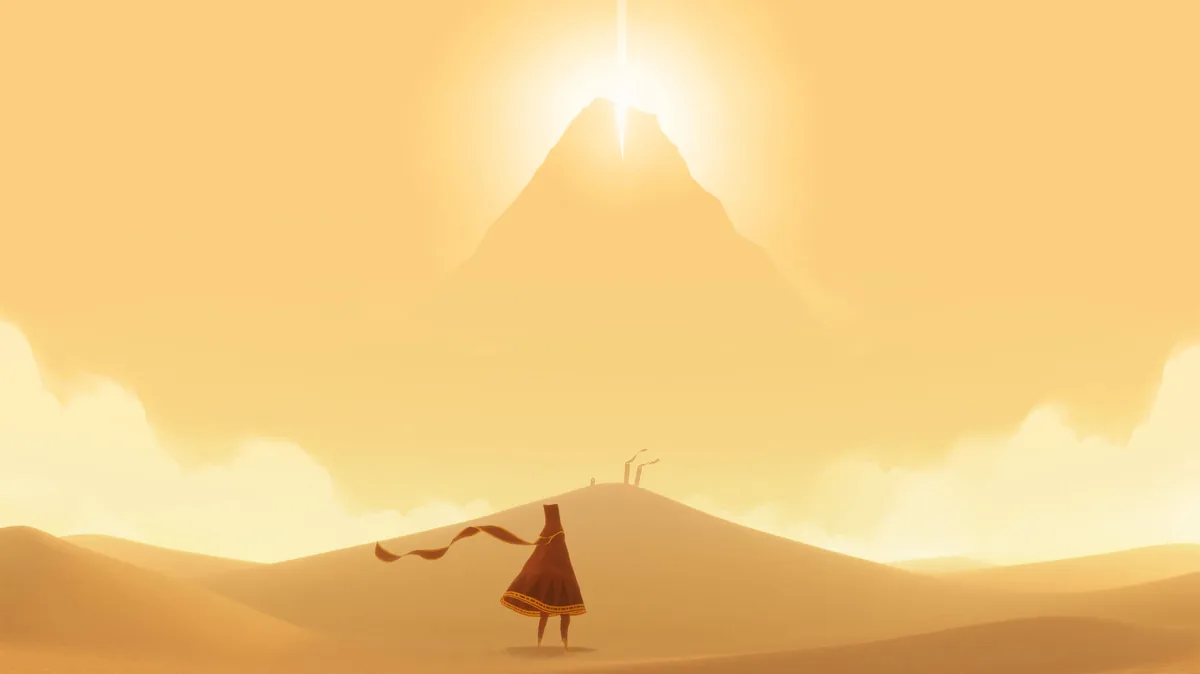
Journey is an indie game placed in a setting of the vast desert. The protagonist is a nameless and speechless figure moving towards the distant mountain. The player gets to know the story without words, but rather through cutscenes. The main character wears a magical scarf, which allows flying for some time, and recharges it with gathered cloth or simply by walking. From time to time the protagonist finds collectible items and discover ruins that can give additional information about the world or the storyline. The only way of interaction with in-game objects is a shout.
The game transfers the atmosphere of an absolute loneliness. However, during the journey the character can meet other players controlling differently dressed, but generally the same figures. Wandering together can be helpful for both players, as they are able to charge one another’s scarves. The thing is that both players cannot communicate each other in any way, except producing noises. Together players can complete levels and continue moving to their final destination.
Sources & attribution
- Game data (release year, genres, platforms, system requirements, description, cover art) via RAWG.io, retrieved 2026-08-21.
- GPU relative-performance indices via TechPowerUp GPU database (relative performance), retrieved 2026-08-29.
- FPS estimates on this page are GameFigs planning estimates from the demand-tier + GPU-index model — not benchmark results.
How the Journey optimization card & FPS estimate are computed
Each game is scored on a 0–9 demand tier from its published PC requirements (and a year/genre fallback when requirements are absent). The FPS estimate compares your selected GPU's relative-performance index against the tier's required index using a diminishing-returns curve, then scales for resolution. The settings card maps the demand tier and your hardware to a starting preset, an FPS band and an upscaler recommendation. All outputs are planning guides — verify in-game with the built-in benchmark when available.
Tools for Journey
Check your hardware against this title, then set your gear up for it.